

Prefer to listen?
Tap here to play it in the Substack app
People imagine the artist’s life as free-spirited and full of inspiration. Waking late, coffee in hand, waiting for the muse to arrive. Then maybe, when the light hits just right, creating something brilliant in a single sitting.
It sounds effortless. Beautiful, even.

New Art Studio in 2024
But for the past 14 years, I’ve shown up to the canvas almost every day, not when I felt like it, not when I was inspired, but because the work needed doing. Over time, that discipline became something much more than habit.
This isn’t a story about chasing creativity. It’s about what happens when you build your life around it…

Old art studio at home for 11 years
In October 2024, I moved into a dedicated studio space for the first time since I began painting. Before that, I worked out of the corner of my bedroom, usually late at night, after full days of work and everything else life asked of me. I painted in silence while the rest of the house slept.
When I became a full-time artist in 2022, I knew I needed something different. A space that could match the scale of what I was creating. I found it in a 120-year-old former shoe factory in Kitchener, Ontario, Canada. Tall ceilings for my largest easel. Wood floors that carry the weight of time. Beams above me, and two oversized windows that now overflow with plants. That wasn’t planned but it’s become one of the things I look forward to seeing every morning.
Now, when I open the door, the rest of the world stays outside. It’s quiet. It’s mine. It’s where the work begins.
Over time, I’ve built a rhythm that holds everything together. At the end of each session, I reset the space. Brushes go back in place, paint laid out just enough to be ready for the next move. When I walk in the next morning, there’s no decision fatigue. I already know where to start.
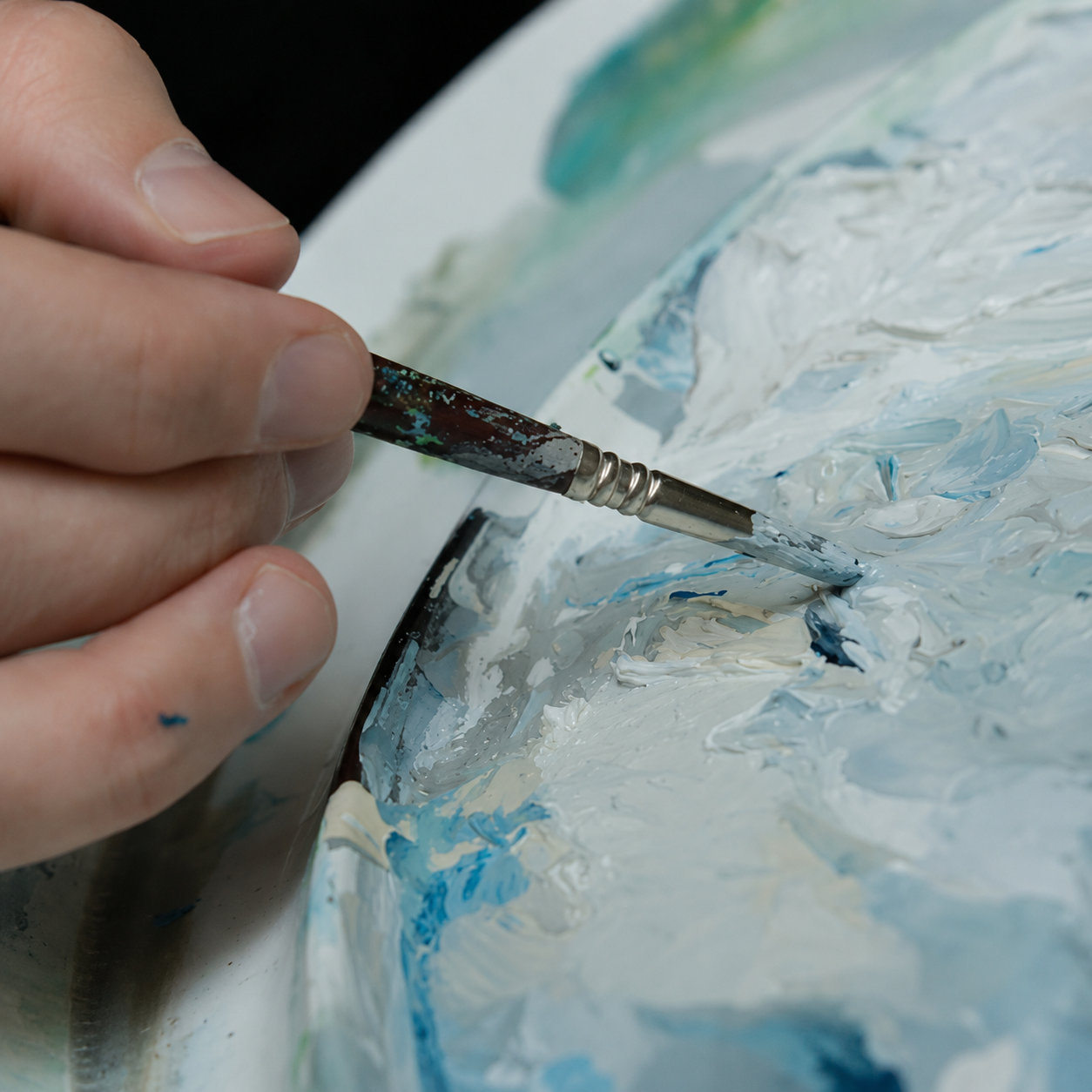
I usually paint for four to six hours a day. It’s not gentle work. People often picture painting as soothing, almost meditative. But the truth is, standing in front of a large canvas for that long, everyday is physical. It takes focus. It wears on your body. I set a timer every 30 to 45 minutes to stretch or move. Some light weights. A bit of walking down the hall to refresh the water. Without it, I’d burn out or get injured.
The ideas themselves rarely arrive while I’m painting. They come when I’m out walking. Or in bed, just as I’m about to fall asleep. I send myself quick notes, or emails, or images. Later, during heavy admin days, I’ll go back and dig through them. I might find an email reference or a phrase I forgot I saved. When I finish a piece, I scroll through those notes and see what pulls at me. More often than not, it’s something I’d forgotten. The next painting is rarely what I had in mind but it always finds its way to the surface.

The beginning of a painting often feels awkward. It’s like trying to fall asleep in unfamiliar surroundings. You’re not fully settled. You’re still thinking. But as the hours pass, something shifts. The lines start to land. The colours start to flow right. Eventually, I find myself deep in the work, tempted to keep going well into the night.
I don’t.
Years of painting have taught me to stop before the energy runs out. Even when I’m in the zone, I’ve learned that pushing too far comes with a cost. The hardest part of a painting is the middle. That’s where the original idea starts to shift. You’re caught between the image you imagined and the one actually unfolding. It’s uncomfortable, but that’s where the decisions matter most.
A good day is clear. I set a goal and finish it. Refining the sky. Adjusting the light. Letting the brush carry just enough motion through the trees.
A bad day? That’s usually the one where I never quite find the rhythm. Too many small things pulling my attention sideways. The hours slip by without that deep focus I need.
Even when I’m not painting, I’m working.
Messages. Print orders. Shipping. Gallery updates. Social media.
It doesn’t look like rest, but the rhythm is different… and that helps. I come back to the canvas more focused, not less.
When I started painting daily, I was still working a more than full-time job. I’d paint from 8 p.m. to midnight, sometimes later. Letting go of that job to pursue art full time was a big leap. There was no paycheque, no safety net, no map. But I committed to showing up.
Now I work seven days a week, painting, managing operations, coordinating deliveries, responding to messages, and keeping everything moving. It’s taken years to find a rhythm that supports it all, and for now, it works. That might change, and if it does, I’ll adjust. People are often surprised by how structured I am, but for me, it’s the only way this life holds together. I plan, follow systems, and get things done. Most days, I’m doing the work of several people… not to impress anyone, but because that’s simply what the work requires.
What makes it sustainable is support. My partner and extended family understand what this life actually takes, both practically and emotionally. That kind of support matters more than most people realize.
What grounds me most is walking at night. It’s quiet. I look up at the stars, listen to the wind, the trees, the insects. My mind slows down. I feel like myself again.
Sometimes I do wonder what I’ve missed by painting this much. Life is full of moments, and I know some have passed me by. But painting is the one thing that’s always been with me. I’ve done it since I was a kid. I don’t see that changing.
Most people would probably be surprised by how much time each painting takes. My style is layered. There’s linework, shape refinement, subtle colour balancing — and a lot of stepping back before moving forward again. I’ve often wished I could paint faster. The ideas come more quickly than I can keep up with. But I’ve learned to accept that I can only do what I can do, and to do it honestly.
I would rather leave behind fewer paintings that feel fully mine than create more that I rushed through just to stay busy.
The communities that have grown around my work, online, in galleries, and in person, mean a lot to me. I’m thankful for every one of them. But the truth is, it hasn’t been easy to build. Sharing art online takes more than people realize. Social media doesn’t just want the work. It wants your presence. Your time. Your energy. On the hard days, it feels like it takes everything before you’ve even picked up a brush.
Even so, it’s where real connection has come from. People who’ve followed quietly for years. Collectors who discovered my work through a single post. Messages from strangers who saw something in the painting that felt personal to them. That kind of support has reached me at times when I’ve needed it most. It’s the extra energy I need to balance it all.
If you’re trying to build a daily art practice, here’s what I’ve learned. Get organized. Learn how to manage your time, your energy, and your money. Understand the business and financial side, even if it feels uncomfortable at first. Build a routine that works for you, and keep showing up to it.
Most important of all: don’t rush. Don’t measure your work against anyone else’s.
This is your life. Fill it with things that make you proud.
~Jeff