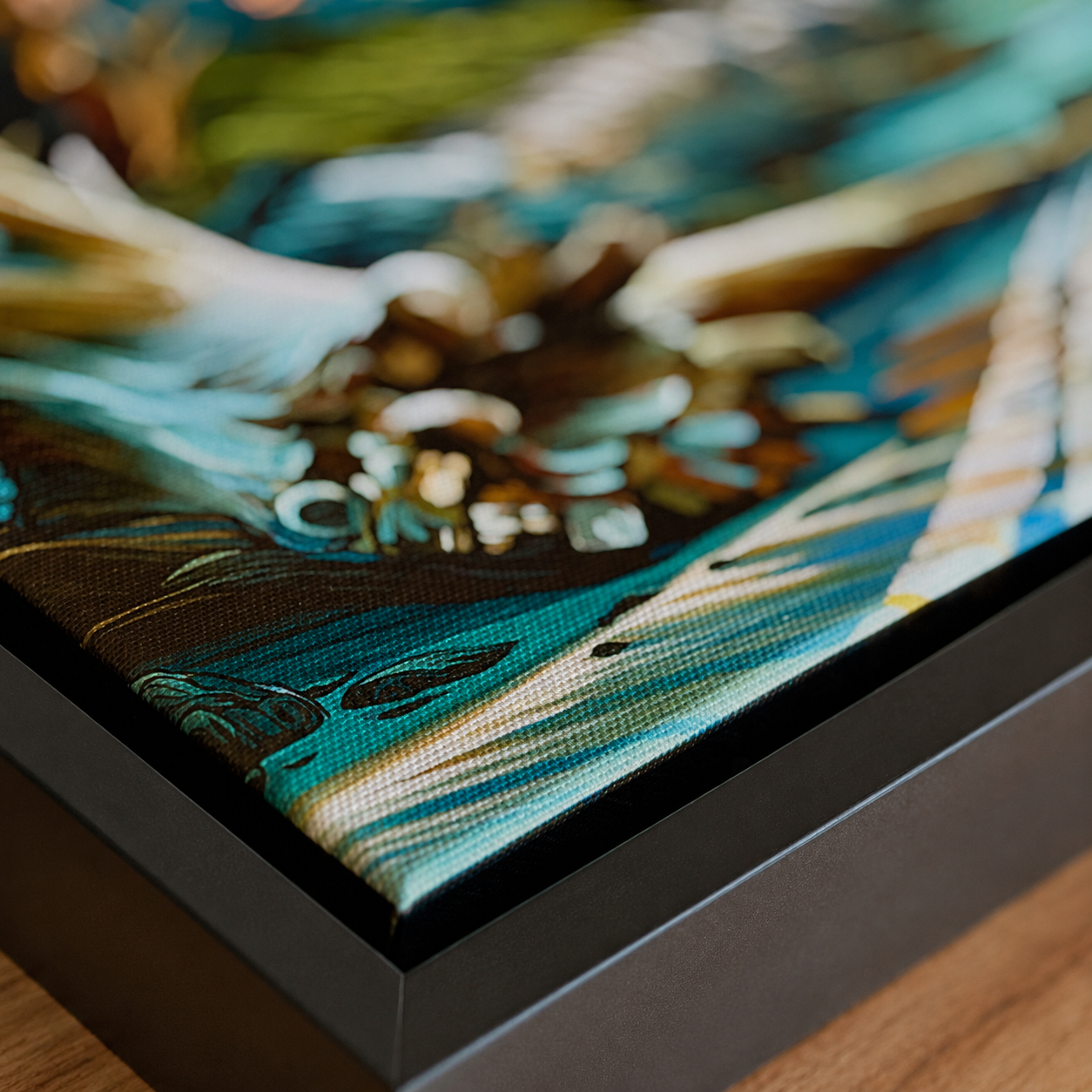


Describing my art style has become easier over time, but I did not start with a clear plan for what it was supposed to be. I painted what I liked, what I saw, and what I felt. Sometimes it was the subject that pulled me in, sometimes the colour, sometimes the movement, and sometimes simply the feeling of putting paint on canvas and seeing where it went.
Over many years of regular painting, certain things kept returning. The bold colour, the black linework, the movement, the natural subjects, and the space between realism and abstraction all became more recognizable to me as I continued working. I do not think I created the style by sitting down and deciding what it should look like. It became clearer through practice. As people began asking me how I would describe my work, I started looking for language that could explain it. That is where references like Cloisonnism, Post-Impressionism, Vincent van Gogh, Celtic art, Gestalt theory, and the Group of Seven became useful. They do not define the work completely, but they help explain parts of what I had already been doing visually for years.
The closest way I can describe my paintings now is that they sit somewhere between realism and abstraction. They are based on forests, lakes, mountains, skies, wildlife, weather, and the natural world, but I am not trying to recreate those subjects exactly as they appear. I want them to feel familiar, but not fixed. A tree still needs to feel like a tree, water still needs to feel like water, and a sky still needs atmosphere, but I am more interested in the movement underneath those things than in recording every detail.
From a distance, most of my paintings come together as recognizable landscapes or natural scenes. You may see a forest, a lake, a bird, a mountain, an animal, or a sky full of movement. As you move closer, the image begins to loosen. The larger subject breaks into smaller areas of colour, line, texture, and shape. Some sections may feel almost abstract on their own. I like that change because it gives the painting more than one way to be seen. It can be clear from across the room, then more mysterious up close.
That is what I mean when I say my work is between realism and abstraction. The subject is still there, but it is not fully spelled out. I do not feel the need to describe every branch, rock, feather, cloud edge, or reflection. Sometimes a painting becomes more interesting when enough information is present, but not everything is completed for the viewer. I often compare it to reading a sentence with a few letters missing. You can still understand the words because enough of the structure remains. Your mind fills in the gaps without much effort. Painting can work in a similar way. If enough of the form is there, the image holds together, even when parts are left open. I think there is something very human in that, because we are always completing things from partial information whether we realize it or not.
The black linework is probably the most recognizable part of what I do. It appeared very early in my paintings and became more important as the work developed. People sometimes call the lines outlines, which I understand, but that is not really how I think of them. They may move around trees, clouds, rocks, animals, or areas of colour, but they are not simply there to trace the edge of things.
For me, the lines create structure, movement, and energy. They help organize the painting, but they also keep it from becoming too still. Your eye naturally follows a line. It wants to know where the line begins, where it travels, what it touches, and how it connects to the rest of the image. I use that instinct throughout the painting. A line might move through trees, cross into water, appear again in a cloud, then circle back through a reflection. The line is less about separating one thing from another and more about guiding the viewer through the whole scene.
One of the closest historical comparisons to parts of my work is Cloisonnism, a Post-Impressionist style where areas of colour are separated by strong dark outlines. It often creates an effect similar to stained glass or cloisonné enamel. I understand why people make that comparison with my paintings. The dark linework and separated colour areas can create that kind of stained-glass feeling, especially when the painting is viewed from a distance. But the comparison only explains part of it. In historical Cloisonnism, the outlines often divide and contain the colour. In my work, the line is more active. It moves through the scene and becomes part of the rhythm of the painting. It helps connect land, water, sky, trees, wildlife, weather, and reflection into one larger movement.
Post-Impressionism is another useful way to understand parts of my work because it moved beyond strict realism. I connect with the idea that colour and form can be expressive without being literal. I may intensify colour, simplify shapes, or strengthen movement so the painting reflects the feeling of a place rather than only what was physically there. I still want the subject to be connected to the natural world, but I do not want it to feel like a direct copy.
Vincent van Gogh comes up often when people talk about movement in my paintings, especially in the skies, trees, spirals, and flowing lines. I understand that comparison. There is a sense in his work that a still painting can hold motion, and that idea has always interested me. I am not trying to imitate Van Gogh, but I am drawn to the way movement can become part of the structure of a painting. Nature is never really still. Clouds shift, trees bend, water changes, light moves, and weather can alter the mood of a place very quickly. I want some of that motion to remain in the finished work.
Celtic art has also been important to me, both visually and personally. My family roots are Irish and Scottish, and I have always felt connected to that part of my background. Visiting Ireland and Scotland deepened that connection. The landscape, history, design, and atmosphere of those places stayed with me, but the Book of Kells made one of the strongest impressions. What interests me in Celtic design is the way line can create flow. Spirals, interlacing forms, and repeated patterns do not simply decorate the surface. They guide the eye. They move, return, connect, and continue. That way of thinking about line feels close to how I approach my own paintings. I like when a line does more than describe something. I like when it pulls one part of the painting into another and gives the image a sense of motion.
Because so much of my work comes from forests, lakes, skies, weather, wildlife, and the Canadian landscape, people sometimes connect it to the Group of Seven. I think that comparison makes sense more in spirit than in direct appearance. The Group of Seven were not simply documenting scenery. They were trying to interpret the land in a way that felt personal, bold, and distinct. They looked at forests, rocks, lakes, weather, and open spaces as something more than a view. I am not trying to paint like them, but I do feel connected to that larger tradition of responding to the Canadian landscape through paint. My approach is different, but the desire to interpret nature rather than simply record it is something I understand.
I am interested in the emotional pull of the natural world, the structure of trees, the movement of clouds, the weight of rock, and the way colour can change the feeling of a place. That does not mean I am trying to turn nature into something unrecognizable. I still want the viewer to feel that connection to land, water, sky, weather, and living things. I just want the image to arrive through my own way of seeing it.
Gestalt theory is another way to think about how my paintings are seen. It looks at how the mind organizes separate visual elements into a whole. That applies to my work because the paintings often rely on many smaller parts coming together in the viewer's mind. Up close, an area might just look like a mark, a curve, a texture, or a patch of colour. From farther away, those pieces begin to connect and the larger image returns. I like that a painting can change depending on where you stand. Up close, I do not necessarily want everything to make immediate sense. I want the viewer's mind to be free of the larger structure for a moment, almost like looking at clouds and trying to make sense of forms that are not completely clear. Then, when you step back, the subject begins to come together again.
The way I build a painting plays into this as well. I do not usually start by drawing all of the black linework. Most of the time, that comes closer to the end. I often begin with an underbody of colour that relates to where the painting is going, then build layers from there. Shapes start broadly and become more refined as the painting develops. Textures appear, forms are condensed, and the painting slowly begins to tell me what it needs.
By the time I add the linework, the painting already has a direction. That is when I decide where the eye should move, where the image needs structure, and how different areas should connect. Sometimes the line defines a form. Sometimes it adds rhythm. Sometimes I leave parts with very little line because colour or texture is doing enough on its own. The linework is not just something underneath the painting. It is part of the final energy of the piece.
It is hard to explain exactly where a personal style comes from. I have enjoyed sketching, drawing, and painting since I was young, and over time you absorb more than you realize. Nature, travel, art history, other artists, architecture, light, colour, texture, memory, and personal experience all find their way into the work somehow. Some influences are easy to name. Others are more difficult to understand.
The more seriously I painted, the more I found myself thinking about what other artists must have gone through while trying to find their own voice. Not only what they painted, but what they kept returning to. What they were trying to solve. What they could not seem to leave alone. I think influence is often more felt than fully understood. You can admire artists, places, and ideas, but your own work still has to pass through your own hands, instincts, decisions, and limits.
For me, this way of painting has developed over more than fifteen years and more than 300 original paintings. It did not happen all at once. The bold colour, black linework, natural subjects, movement, atmosphere, and balance between realism and abstraction came together slowly through repetition, curiosity, and a lot of adjustment. Cloisonnism, Post-Impressionism, Van Gogh, Celtic art, Gestalt theory, and the Group of Seven all help explain parts of what I do, but none of them fully define it. My work is still rooted in landscape painting, but it is not literal landscape painting. It is expressive, but still connected to recognizable subjects. It is structured, but always trying to move. That is probably the most honest way I can describe my style. It is my way of seeing the natural world, breaking it apart, and putting it back together through line, colour, rhythm, texture, and feeling.
Quick Q&A About My Art Style
What style of art does Jeff Dillon create?
I create contemporary landscape paintings that sit between realism and abstraction. My work uses bold colour, flowing black linework, texture, rhythm, and movement to express the feeling of nature rather than copy it exactly.
Is Jeff Dillon's art realistic or abstract?
It is both. From a distance, my paintings are usually recognizable as landscapes, wildlife, forests, lakes, skies, mountains, or natural scenes. Up close, they often become more abstract, breaking into line, shape, colour, pattern, and texture.
Why does Jeff Dillon use black lines in his paintings?
I use black lines to create structure, movement, and energy. I do not think of them as simple outlines. The lines guide the viewer's eye through the painting and help connect different parts of the composition.
How does Jeff Dillon create his paintings?
I usually begin with an underlayer of colour and build the painting gradually through layers. Shapes start broadly and become more refined over time. The black linework is often added later in the process to guide movement, define structure, and connect different parts of the image.
What art movements relate to Jeff Dillon's style?
My work has connections to Cloisonnism, Post-Impressionism, Gestalt theory, Celtic art, Vincent van Gogh's sense of fluid movement, and the Canadian landscape tradition of the Group of Seven. These are reference points, not strict labels.
Is Jeff Dillon's work inspired by Celtic art?
Yes. Celtic art has influenced how I think about line, spirals, pattern, and movement. My Irish and Scottish roots, along with visits to Ireland and Scotland, have deepened that connection. The Book of Kells has also been an important visual reference for me.
Is Jeff Dillon's work inspired by the Group of Seven?
My work connects to the Group of Seven mainly through Canadian subject matter and the broader tradition of interpreting the landscape in a personal way. I am not trying to imitate their work, but I do feel connected to the idea of creating a distinct response to the natural world.
What makes Jeff Dillon's paintings recognizable?
My paintings are recognizable because of their bold colour, flowing black linework, strong movement, and the way they shift between realism and abstraction. From a distance, the subject comes together. Up close, the painting reveals more abstract patterns, textures, and rhythms.
Why do Jeff Dillon's paintings look different up close?
From a distance, the image reads as a complete landscape or natural scene. Up close, the painting breaks into smaller elements like line, texture, and colour. This shift allows the work to be experienced in more than one way.
What materials does Jeff Dillon use?
I work primarily with heavy body acrylic paint on canvas. I build up layers of colour, texture, and line to create depth and movement within the painting.
What is Cloisonnism in art?
Cloisonnism is a style developed in the late 1800s where areas of flat colour are separated by bold, dark outlines. It was used by artists like Paul Gauguin and Émile Bernard and often creates a stained-glass-like effect.
What is Post-Impressionism?
Post-Impressionism is an art movement that followed Impressionism in the late 19th century. Artists like Vincent van Gogh, Paul Cézanne, and Paul Gauguin focused more on structure, emotion, and symbolic colour rather than just capturing light and realism.
What is Gestalt theory in art?
Gestalt theory is a psychological concept that explains how people naturally organize visual elements into complete forms. In art, it helps explain how viewers can see a whole image even when it is made up of many separate parts.
Who were the Group of Seven?
The Group of Seven were a group of Canadian landscape painters active in the early 20th century. Key members included Lawren Harris, A.Y. Jackson, Franklin Carmichael, Arthur Lismer, J.E.H. MacDonald, Frederick Varley, and Frank Johnston. They are known for developing a bold and expressive style of painting inspired by the Canadian wilderness.
Further Reading
- Jeff Dillon, The Artist, official biography and Curriculum Vitae (CV)
- Cloisonnisme and Paul Gauguin, National Gallery of Art.
- After Impressionism, from Neo-Impressionism to Fauvism, Musée d'Orsay.
- Vincent van Gogh, Van Gogh Museum.
- The Group of Seven, Tom Thomson and Their Contemporaries, McMichael Canadian Art Collection.
- Gestalt Principles of Organization, Tate Figure it out
- Celtic Art and history