

Prefer to listen?
Tap here to play it in the Substack app
Most people assume lighting a painting is a technical problem. You hang the work, aim a light at it, and trust that brightness alone will do the rest.
It rarely does.
I’ve watched paintings change completely once they leave the studio. Not because the work itself changed, but because the room did. A painting that felt calm can start to feel unsettled on the wall. Areas that once held together begin to drift apart. Other times, something finally falls into place, and the work reads more clearly than it ever did in the studio.
Light is usually the reason.
What surprises people is how little this has to do with buying the right fixture. It has much more to do with patience. With standing in the room longer than we’re used to. With paying attention to when a painting starts to feel strained and when it doesn’t.

The first thing I notice, almost without thinking about it anymore, is scale. Small works don’t respond well to being flooded with light. Large works often need more presence than people expect. Beyond that, everything gets murkier. Wall colour begins to matter. Ceiling height. Where the windows are. What time of day you’re usually in the room. The painting stops behaving like an isolated object and starts responding to the space around it.

This is why I usually suggest waiting before committing to anything permanent. Move the painting. Live with it for a few days. Look at it early in the morning, then again in the evening when the light drops and softens. There’s often a moment when something clicks, even if you can’t quite explain what changed.
Too much light strips colour away. Poorly placed light breaks up the surface, pulling attention to areas that were meant to work together. These are small shifts, but paintings react quickly to them.
A piece like Captivating, for example, doesn’t want to be spotlighted. It works best when the light is steady and consistent, present without calling attention to itself.

Artificial light complicates things further. The most common mistake I see is light coming straight down from overhead, as if the painting were a countertop. That kind of light almost always creates problems. Hard shadows. Glare across the surface. A feeling that the work is being examined rather than allowed to exist in the room.
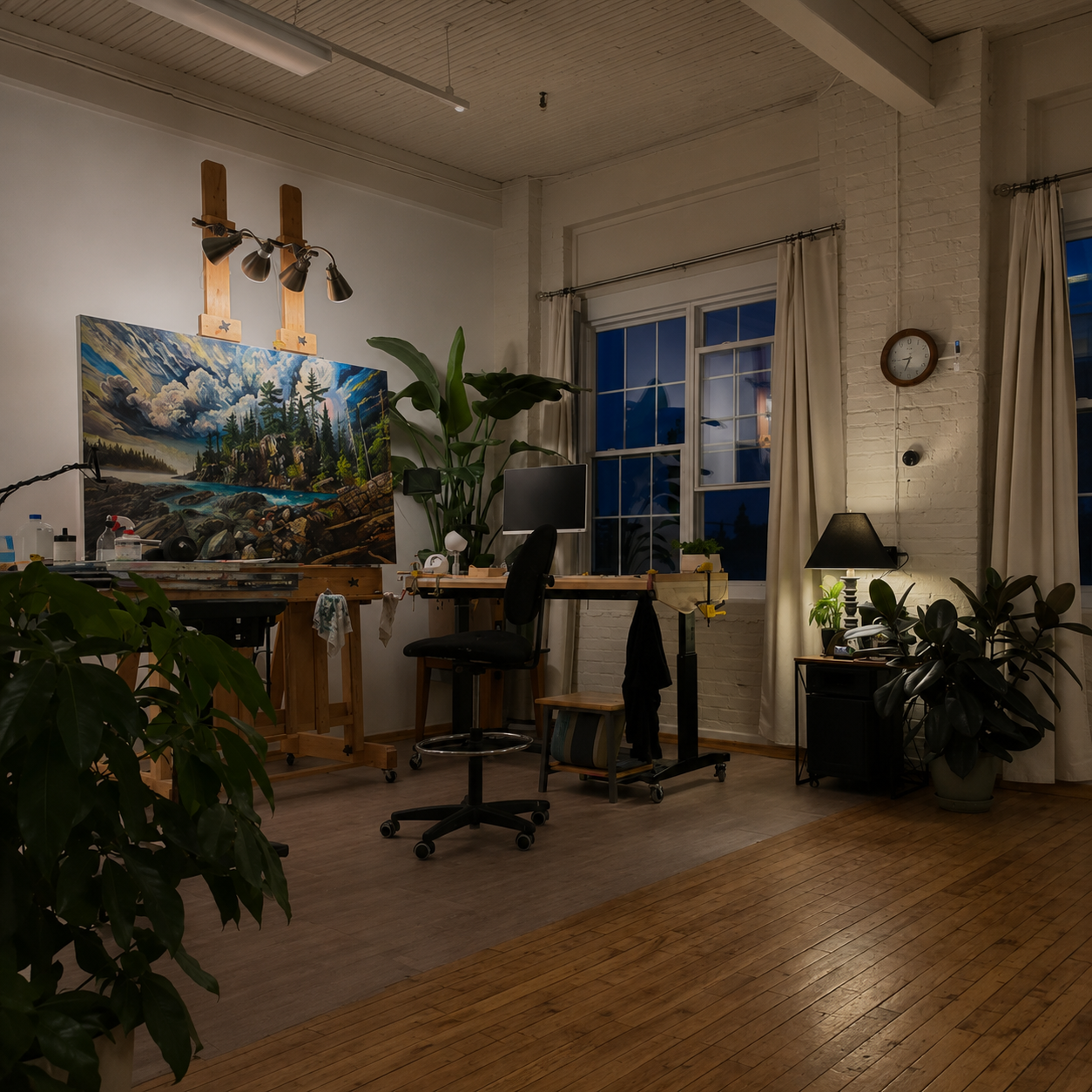
Angling the light changes everything. It doesn’t need to be precise. It just needs to be considered. Floor lamps, table lamps, track lighting, ceiling fixtures. All of them can work when the light approaches the surface instead of pressing down on it.

High ceilings add another layer. Distance matters. A beam that’s too wide often loses its effect before it reaches the painting. A slightly stronger, more focused light can bring the work back into the space where it belongs. When this is done well, the light recedes and the painting becomes the first thing you notice. Follow the Sun holds its warmth best this way, supported quietly rather than competed with.
There are other tools, of course. Spotlights offer control. Picture-mounted lights can help define a piece within a larger wall. Battery-powered options work for some spaces, plug-in fixtures for others. None of these choices are inherently better. What matters is how the painting behaves once the light is on.
Colour temperature is one of those details people often overlook until they see it firsthand. Warmer light softens a painting. Cooler light sharpens it. Neither is right or wrong. A darker work like Dusk can shift noticeably with even a small change, sometimes gaining depth, sometimes losing it.

At a certain point, numbers stop being helpful. This is where trusting your eye matters more than specifications. Spend time with the work. Let it show you when it feels settled instead of trying to force it into a technical ideal.
Natural light is always part of the conversation, whether we plan for it or not. It moves throughout the day. It changes with the season. Sometimes that variation brings a quiet sense of life to a painting that artificial light can’t quite replicate. The only real caution is prolonged direct sunlight on the surface. Beyond that, diffused daylight often reveals details worth noticing.
There’s no formula for lighting artwork at home, and that’s probably why it’s worth thinking about at all. Every space asks for something slightly different. Every painting responds in its own way. Paying attention, making small adjustments, and giving yourself time to notice the changes usually leads somewhere better than chasing a perfect setup.
Paintings are meant to live with you. Finding the right light becomes part of that relationship.
Thanks for reading.
~Jeff