

¿Prefieres escucharlo?
Toca aquí para reproducirlo en la aplicación Substack

El Grupo de los Siete, junto con Tom Thomson y Emily Carr, cambió la forma en que se percibía el arte canadiense. En una época en que las tradiciones europeas aún moldeaban gran parte del mundo artístico, estos artistas dirigieron su atención a los bosques, lagos, cielos, rocas, pueblos y paisajes agrestes de Canadá. No se limitaban a pintar paisajes. Intentaban mostrar el país de una manera sincera, audaz y distinta de las tradiciones anteriores.
Cada artista siguió un camino distinto, pero compartían la convicción de que el paisaje canadiense merecía pintarse con fuerza, color y originalidad. Su obra cuestionó las ideas tradicionales sobre cómo debía ser el arte y ejerció una influencia duradera en los artistas que vinieron después.

A.J. Casson:
Alfred Joseph Casson, conocido como A.J. Casson, nació el 17 de mayo de 1898 en Toronto, Ontario. Se convirtió en el miembro más joven del Grupo de los Siete cuando se unió en 1926. Mientras muchos miembros del grupo se centraban en zonas silvestres remotas, Casson se hizo especialmente conocido por sus pinturas de pueblos de Ontario, caminos rurales, iglesias, graneros y paisajes de pequeñas localidades.
Su obra suele tener una estructura serena. Casson tenía buen ojo para las formas, el color y la composición, probablemente gracias a su larga trayectoria en el arte comercial y el diseño. Sus pinturas mostraban que el paisaje canadiense no se encontraba solo en vastos bosques y lagos del norte, sino también en los lugares familiares por los que la gente pasaba todos los días.
Además de pintar, Casson se mantuvo activo en la comunidad artística de Canadá. Participó activamente en la Ontario Society of Artists y fue su presidente, contribuyendo a apoyar a los artistas canadienses y a preservar la historia del arte del país. Cuando murió, el 20 de febrero de 1992, en Toronto, dejó un amplio legado de obras estrechamente vinculadas con Ontario y el arte canadiense.

A.Y. Jackson:
Alexander Young Jackson, conocido como A.Y. Jackson, nació el 3 de octubre de 1882 en Montreal, Quebec. Como uno de los miembros fundadores del Grupo de los Siete, ayudó a encaminar el arte canadiense hacia una identidad propia al tratar los paisajes del país como temas dignos de ser pintados. Jackson recorrió Canadá de punta a punta, pintando desde la costa atlántica hasta las Montañas Rocosas y, a menudo, trabajando al aire libre para estudiar directamente el territorio. A lo largo de su vida, realizó más de 2.500 pinturas, lo que lo convirtió en uno de los artistas más prolíficos vinculados al grupo.
Jackson también participó en la Primera Guerra Mundial. Fue herido durante la guerra y más tarde se convirtió en artista oficial de guerra, una experiencia que añadió otra dimensión a su forma de ver a las personas, los lugares y el paisaje. Tras la disolución del Grupo de los Siete en 1933, siguió desempeñando un papel importante en el arte canadiense a través del Grupo Canadiense de Pintores, fundado ese mismo año.
También enseñó en la Escuela de Bellas Artes de Banff, en Alberta, y en el Colegio de Arte de Ontario, hoy Universidad OCAD, en Toronto. Tanto con sus pinturas como con su labor docente, Jackson influyó en muchos artistas de generaciones posteriores. Murió por causas naturales el 5 de abril de 1974 en Kleinburg, Ontario, a los 91 años.

Lawren Harris:
Lawren Stewart Harris nació el 23 de octubre de 1885 en Brantford, Ontario, y se convirtió en una de las figuras centrales del Grupo de los Siete. No solo fue miembro fundador, sino también una de las personas que hicieron posible el grupo. Proveniente de una familia adinerada, Harris contaba con los medios para apoyar a otros artistas, organizar viajes para pintar y ayudar a crear el espacio necesario para que surgiera una nueva forma de arte canadiense. Su papel fue más allá de la pintura. Ayudó a dar dirección, confianza e impulso al movimiento.
Harris contribuyó a forjar la idea de que la pintura de paisajes canadiense podía tener una identidad propia, independiente de la tradición europea. Sus primeras obras se centraban en lugares como Algoma, el lago Superior y el Ártico, con formas contundentes, luz clara, colores intensos y formas simplificadas. Sus paisajes suelen transmitir quietud y fuerza, como si se hubieran reducido a sus formas esenciales.
Para la década de 1930, Harris había dejado atrás la pintura de paisajes realistas y se había inclinado por la abstracción. Su interés por la espiritualidad y la teosofía influyó en este cambio, y su obra posterior se volvió más simbólica y menos ligada a lugares específicos. En 1940, se mudó a Estados Unidos y vivió un tiempo en Santa Fe, Nuevo México, antes de establecerse finalmente en Vancouver, Columbia Británica, donde su obra siguió evolucionando.
Algunas de sus obras más conocidas son “Lake Superior” (c. 1923), “North Shore, Lake Superior” (c. 1926) y “Mount Lefroy” (c. 1930). Harris también apoyó a otros artistas, ayudó a organizar exposiciones y aprovechó su posición para fortalecer el arte canadiense en una época en que todavía luchaba por obtener reconocimiento. Murió por causas naturales el 29 de enero de 1970 en Vancouver, a los 85 años.

J.E.H. MacDonald:
J.E.H. MacDonald nació el 12 de mayo de 1873 en Durham, Inglaterra, y se trasladó a Canadá con su familia en 1887. Fue uno de los miembros fundadores del Grupo de los Siete y desempeñó un papel importante en la definición de los primeros pasos del movimiento. Antes de darse a conocer por sus pinturas de paisajes, MacDonald trabajó en diseño gráfico, lo que le ayudó a perfeccionar su sentido de la composición, el color y la estructura.
MacDonald pintó muchos lugares de Canadá, entre ellos Algoma, la bahía Georgian y las Montañas Rocosas. Su obra solía transmitir una intensa carga emocional; empleaba colores vivos y movimiento para expresar cómo se sentía el paisaje, no solo cómo se veía. Dos de sus obras más conocidas son “The Solemn Land” (1921) y “Mist Fantasy, Northland” (1922).
Un aspecto menos conocido de la carrera de MacDonald fue su trabajo en la iglesia anglicana de St. Anne, en Toronto. En 1923, fue contratado para diseñar las obras de arte del interior de la iglesia e invitó a otros nueve artistas a ayudar a completar el proyecto, entre ellos Franklin Carmichael y Frederick Varley. Más tarde, los murales fueron reconocidos como parte de un sitio histórico nacional, lo que convierte a la iglesia en un raro ejemplo de arte religioso vinculado con miembros del Grupo de los Siete.
MacDonald también fue profesor, mentor y una figura importante de la comunidad artística de Toronto. Sus obras se encuentran en importantes colecciones de todo Canadá, como la Galería Nacional de Canadá y la Galería de Arte de Ontario. Murió tras sufrir un derrame cerebral el 26 de noviembre de 1932, a los 59 años, y dejó una obra que contribuyó a definir cómo se pintaba y se entendía el paisaje canadiense.

Arthur Lismer:
Arthur Lismer nació el 27 de junio de 1885 en Sheffield, Inglaterra, y más tarde se trasladó a Canadá, donde se convirtió en uno de los miembros fundadores del Grupo de los Siete. Sus pinturas son conocidas por sus pinceladas enérgicas, sus colores intensos y sus interpretaciones expresivas del paisaje. Mientras muchos de sus compañeros del grupo se centraban en la naturaleza salvaje de Canadá, Lismer solía aportar a su obra una sensación de movimiento y personalidad.
Aunque tuvo un papel importante en el Grupo de los Siete, gran parte de la influencia de Lismer se debió a la educación. En 1927, se convirtió en vicedirector de la Escuela de Arte de Ontario, hoy Universidad OCAD. Más adelante, desarrolló programas de educación artística en la Galería de Arte de Toronto, hoy Galería de Arte de Ontario, y en el Museo de Bellas Artes de Montreal. Su enseñanza fomentó la creatividad, la observación y la expresión personal, y contribuyó a dar forma a la enseñanza del arte en Canadá.
Lismer siguió pintando durante toda su vida y produjo una obra extensa, con aproximadamente 800 piezas atribuidas a él. Murió por causas naturales el 23 de marzo de 1969, a los 83 años. Su influencia sigue siendo importante, no solo por lo que pintó, sino también por la cantidad de personas a las que acercó al arte.

Frederick Varley:
Frederick Horsman Varley nació el 2 de enero de 1881 en Sheffield, Inglaterra, y se convirtió en uno de los miembros fundadores del Grupo de los Siete. Aunque contribuyó a transformar el paisaje canadiense en un tema digno de la pintura, su obra abarcó mucho más que los paisajes. Varley sentía una profunda atracción por el retrato y la vida emocional de las personas que pintaba. No se trataba simplemente de una diferencia de estilo respecto a otros miembros del grupo, sino de algo ligado a sus propias experiencias, dificultades y sensibilidad como artista.
A lo largo de su vida, Varley enfrentó dificultades económicas y personales que influyeron tanto en su enfoque como en su producción. A diferencia de muchos de sus contemporáneos, que se centraban principalmente en la naturaleza salvaje canadiense, Varley solía interesarse por el rostro y el espíritu humanos. Sus retratos suelen recordarse por la manera en que captan tanto el aspecto como la personalidad de las personas que pintó. Su pintura de 1931, “Vera”, suele considerarse una de las grandes obras del retrato canadiense.
Varley también fue educador; enseñó en la Escuela de Artes Decorativas y Aplicadas de Vancouver, hoy Universidad Emily Carr de Arte y Diseño, y en la Escuela de Arte de Ontario, hoy Universidad OCAD. Con su labor docente, influyó en artistas más jóvenes al transmitirles su convicción en el poder emocional y expresivo del arte. A pesar de las dificultades que enfrentó, Varley produjo más de 1.000 obras a lo largo de su vida, entre ellas paisajes y retratos. Murió por causas naturales el 8 de septiembre de 1969, a los 88 años.

Franklin Carmichael:
Franklin Carmichael nació el 4 de mayo de 1890 en Orillia, Ontario, y se convirtió en el miembro fundador más joven del Grupo de los Siete. Aportó una voz distintiva al grupo mediante el uso del color, el diseño y la acuarela, y ayudó a ampliar las posibilidades de representar el paisaje canadiense.
Carmichael trabajó tanto con óleo como con acuarela, y su estilo alternaba entre una pintura suelta y atmosférica y un enfoque más estructurado y gráfico. Su atención a la luz, el color y las estaciones daba a sus paisajes un marcado sentido del lugar sin hacerlos demasiado literales. En 1925, fue miembro fundador de la Canadian Society of Painters in Water Colour y ayudó a promover esta técnica en una época en que a menudo se la consideraba secundaria frente a la pintura al óleo. Obras como “Autumn in Orillia”, “Mirror Lake” y “October Gold” muestran su capacidad para captar el carácter cambiante del paisaje canadiense mediante composiciones sólidas y colores vivos.
La contribución de Carmichael al arte canadiense también se extendió a la enseñanza. Enseñó en el Ontario College of Art, ahora OCAD University, donde influyó en artistas más jóvenes y fomentó la apertura tanto a los enfoques tradicionales como a los nuevos en la pintura. Es difícil confirmar el número exacto de obras que creó, pero a lo largo de su carrera produjo cientos de pinturas, dibujos y acuarelas. Murió de un ataque al corazón el 24 de octubre de 1945 en Toronto, Ontario, a los 55 años.

Frank Johnston:
Frank Johnston, quien más tarde adoptó el nombre de Franz Johnston, nació el 19 de junio de 1888 en Toronto, Ontario. Estudió en la Central Ontario School of Art and Design y fue uno de los miembros fundadores del Grupo de los Siete en 1920. Aunque su etapa en el grupo fue relativamente breve, formó parte de sus inicios y contribuyó a su impulso hacia un enfoque más claramente canadiense de la pintura de paisajes.
Johnston dejó oficialmente el Grupo de los Siete en 1924 y emprendió un camino más independiente. Tras adoptar el nombre de Franz Johnston, su obra fue más allá del enfoque habitual del grupo en los paisajes silvestres. Pintó escenas urbanas, motivos florales, auroras boreales, lagos y otros paisajes de Canadá, mostrando una variedad más amplia de la que a veces se le reconoce.
Sus pinturas se caracterizan por sus colores intensos, movimiento y energía. A lo largo de su carrera, produjo una obra considerable, aunque es difícil confirmar el número exacto de pinturas y obras de arte que creó. Johnston también enseñó en la Escuela de Arte de Winnipeg y en el Ontario College of Art, e influyó en artistas canadienses más jóvenes tanto con su labor docente como con sus propias pinturas.
Franz Johnston murió por causas naturales el 19 de julio de 1949 en Toronto, a los 61 años. Su obra sigue formando parte de numerosas colecciones públicas y privadas de Canadá, y ocupa un lugar importante en la historia del Grupo de los Siete, aunque eligió un rumbo diferente desde el principio.

Emily Carr:
Emily Carr nació el 13 de diciembre de 1871 en Victoria, Columbia Británica, y se convirtió en una de las figuras más importantes del arte canadiense. Aunque nunca fue miembro oficial del Grupo de los Siete, su obra compartía un deseo similar de alejarse de la tradición europea y encontrar una manera más directa de pintar el paisaje canadiense. Como única mujer mencionada en este artículo, Carr siguió un camino propio. Tuvo que abrirse paso en una época en que las artistas solían recibir menos reconocimiento, y su éxito llegó tras años de perseverancia, aislamiento y dudas.
Carr es conocida sobre todo por sus pinturas de los bosques, las costas y los sitios culturales indígenas del noroeste del Pacífico. Su obra solía transmitir una intensa espiritualidad, con árboles, cielos y formas talladas pintados con movimiento, peso y presencia. Tras estudiar en Europa, regresó a Columbia Británica con una visión más sólida de la pintura moderna, pero desarrolló una voz propia. Su estilo estuvo marcado por el postimpresionismo, el modernismo y su profunda conexión con el paisaje de la costa oeste.
Su exposición de 1927 con el Grupo de los Siete marcó un importante punto de inflexión en su carrera. Presentó su obra a un público nacional más amplio y la acercó a artistas que también intentaban definir un enfoque canadiense de la pintura. Aunque nunca formó parte del grupo, Carr suele mencionarse junto a sus integrantes porque su obra contribuyó a ampliar la idea de lo que podía ser el arte canadiense.
Carr también fue escritora. Su libro “Klee Wyck” ganó el Premio del Gobernador General y reflexiona sobre su vida, sus viajes y sus experiencias con comunidades indígenas. Hoy, sus obras se encuentran en importantes colecciones, como la Galería Nacional de Canadá y la Galería de Arte de Vancouver. Emily Carr murió el 2 de marzo de 1945, a los 73 años, tras sufrir un infarto y años de problemas de salud. Sus pinturas y escritos siguen siendo fundamentales en el arte canadiense, en especial por la poderosa voz que dio a los bosques y paisajes de Columbia Británica.

Tom Thomson
Tom Thomson nació el 5 de agosto de 1877 en Claremont, Ontario, y suele mencionarse junto al Grupo de los Siete, aunque murió antes de que el grupo se formara oficialmente. Su influencia en los artistas que más tarde formarían el Grupo de los Siete fue enorme, sobre todo por la manera directa, enérgica y emotiva en que pintaba la naturaleza salvaje de Canadá.
Thomson está estrechamente asociado con el parque Algonquin, donde trabajó como guía y pasó largos períodos haciendo bocetos al aire libre. En menos de una década de dedicación seria a la pintura, produjo unos 400 bocetos al óleo sobre pequeños paneles de madera y aproximadamente 50 lienzos de mayor tamaño. Su obra es conocida por sus colores audaces, pinceladas enérgicas y respuesta directa al paisaje que lo rodeaba. Pinturas como “El pino torcido” y “El viento del oeste”, ambas de 1916 a 1917, siguen estando entre las imágenes más conocidas del arte canadiense.
Parte del lugar perdurable de Thomson en la cultura canadiense también se debe al misterio que rodea su muerte. El 8 de julio de 1917, lo encontraron muerto en el lago Canoe, en el parque Algonquin, a los 39 años. Las circunstancias exactas nunca se han esclarecido del todo y, con el tiempo, su muerte pasó a formar parte de la historia más amplia de su vida y su obra. Ese final trágico y sin resolver contribuyó a que Thomson se convirtiera en algo más que un pintor influyente. Se convirtió en una figura perdurable en la imaginación canadiense, vinculada al paisaje salvaje que pintó y a las preguntas que aún rodean sus últimos días.
Su carrera fue breve, pero su impacto en el arte canadiense perduró. Thomson ayudó a abrir el camino a una forma más personal e inconfundiblemente canadiense de pintar el paisaje, y su influencia se aprecia en la obra del Grupo de los Siete y de muchos artistas que vinieron después.

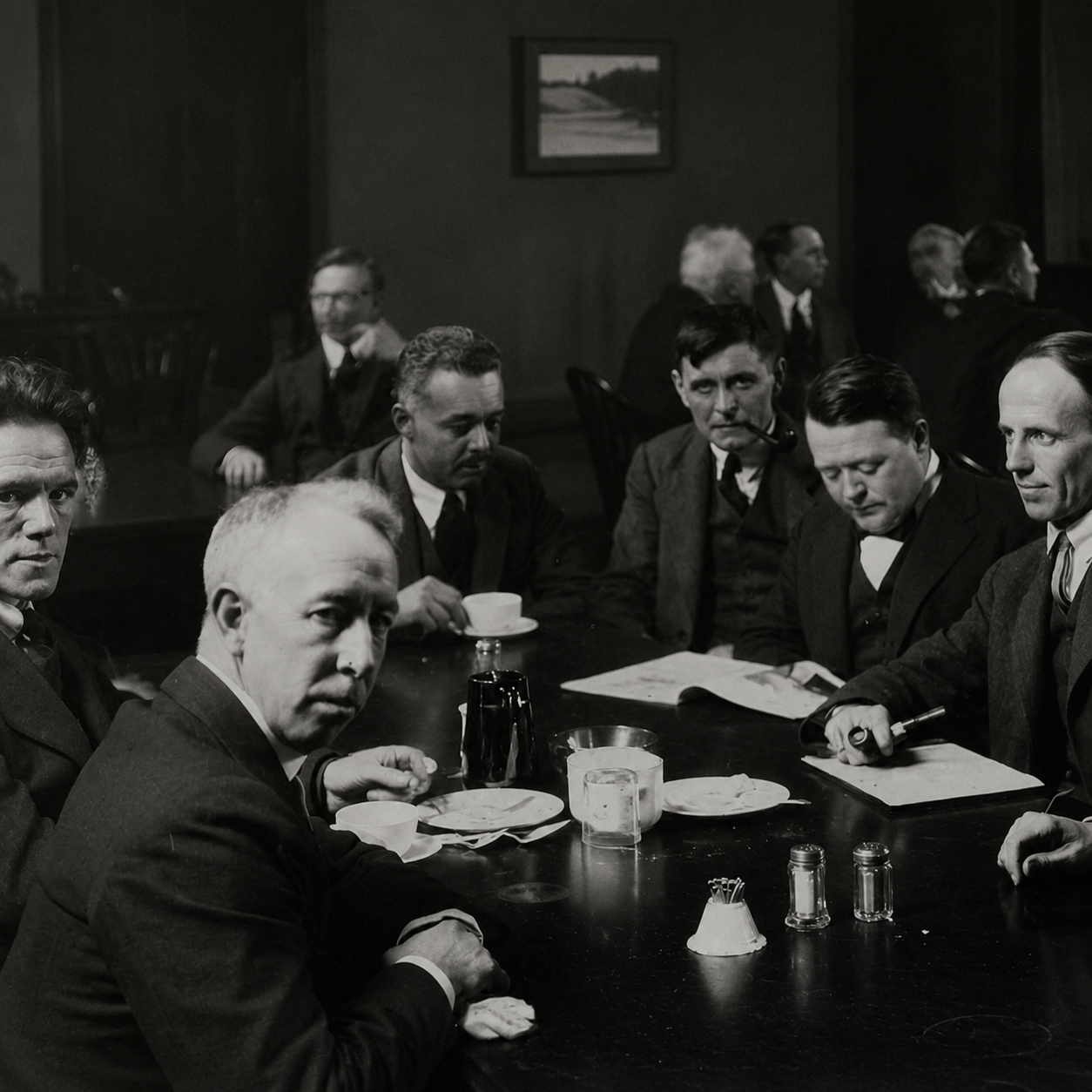
Frederick Varley, A. Y. Jackson, Lawren Harris, Barker Fairley (no era miembro), Frank Johnston, Arthur Lismer y J. E. H. MacDonald. Imagen de ca. 1920, F 1066, Archivos de Ontario, I0010313
El Grupo de los Siete, Tom Thomson y Emily Carr contribuyeron a dar forma a la manera en que se entiende hoy el arte canadiense. No todos siguieron el mismo camino, pero compartían la convicción de que el paisaje canadiense merecía ser pintado con fuerza, originalidad y sentimiento. Su obra sigue siendo importante porque ayudó a artistas y espectadores a ver este país de otra manera.
Para mí, aprender más sobre sus vidas hace que las pinturas cobren aún más vida. La obra es importante por sí sola, pero las historias que hay detrás le añaden otra dimensión: los lugares que recorrieron, los riesgos que asumieron, las dificultades personales que afrontaron y la forma en que siguieron esforzándose por crear algo inconfundiblemente canadiense.
Si quieres explorar más de su obra o aprender más sobre el Grupo de los Siete, Tom Thomson y Emily Carr, estos recursos son un buen punto de partida:
Gracias por leer
Jeff